Map of the Grasslands 7: Yellowstone Grasslands – A Silent Agreement Between Geothermal Heat and Bison
In Yellowstone National Park in the western United States, the grasslands don’t exist alone.
They coexist with geysers, volcanoes, steam, and sulfur.
And the bison that roam among them are like guardians of an ancient agreement—
they don’t speak, but they remember it all.
At the edge of the grassland, the earth is quietly boiling
Yellowstone isn’t your typical grassland. It’s the lichen of an active volcano, a green skin covering geothermal activity.
Walking through the grassy plains, you’ll suddenly smell sulfur and hear the gurgling of water boiling underground. Next to the grassy plains are hot springs and geysers, with steam rising from cracks in the ground like the breath of invisible creatures.
This is an unstable grassland, a constant reminder that
what lies beneath your feet is not earth, but waiting energy.
Bison are the most silent voice on this grassland
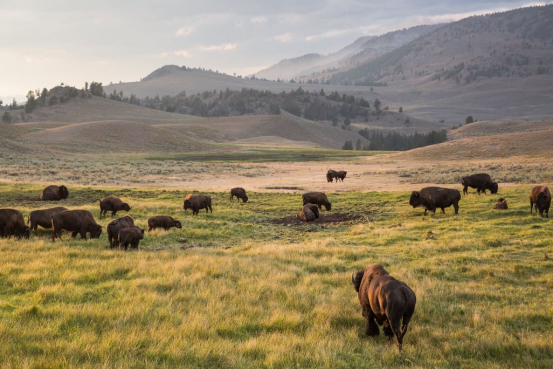
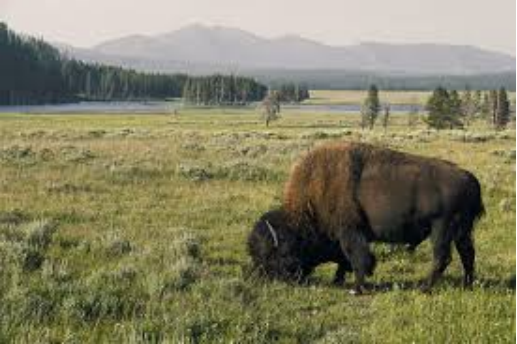
The most famous inhabitants of the Yellowstone grasslands are not plants but bison, which are huge, quiet, and slow-moving, as if they do not belong to the modern era.
In spring, they lie in the warm geothermal areas, warming newborn calves with sulfur-soaked steam. In winter, they lower their heads in the snow to find grass swept away by the wind.
You can’t really get close to them. There’s an old-time distance between them and humans—
not fear, but an old understanding of “please don’t get too close.”
They are like the first audience of this world, watching the earth rolling but never leaving their seats.
Grassland plants live between heat and cold
Yellowstone’s grassland plants are not particularly tall or lush, but they are extremely adaptable.
Some grasses grow on the edge of hot springs, close to the boiling point but not burned; some are hidden in cold wind vents, only emerging for a while after the snow melts; and more, like migratory birds, move their roots with the will of the seasons.
Rather than conquering growth, they have learned to live with the changes of the earth.
Botanists say that the distribution of grass here is like the shadow of a geothermal map – the grass knows where it is hot and where it is cold, and understands the temperature earlier than humans.
The grassland is not wide, but it hides the fault of time.
From a distance, the grasslands of Yellowstone are not vast. Compared with the African grasslands or the Mongolian plateau, it looks like an oasis compressed by volcanoes.
But time has accumulated here.
Volcanic ash from 10,000 years ago is still buried deep in the soil,
the footprints of ancient Indians lie dormant beneath the stones,
and the notes of explorers who visited here in the 19th century have now become “mythical literature.”
The Yellowstone grasslands make people realize that vastness does not necessarily lie in area, sometimes it lies in depth.
Geothermal energy is the breath of the grassland, not the background
Many tourists rush by, thinking that the grassland is just a decorative feature of the scenery with geysers
.
Geothermal activity is the lungs of the grasslands. Without it, bison wouldn’t survive the winter, and spring grass wouldn’t sprout early.
The energy beneath the volcano is slowly released, creating a resilient ecosystem on the surface.
This “thermal grassland” is a rare sight on human maps.
It makes us understand in a new way: life is not about choosing the softest soil, but about finding the most real energy outlet.
It is not humans who have achieved peace with the Earth
The Yellowstone grassland area looks like a “national park”, but it was not built for humans.
Standing in the meadow, you can sense a subtle sense of exclusivity: bison don’t hide from you when they pass by, hot springs don’t wait for you when they erupt, and even the grass blooms and seeds at its own pace.
The agreement here has long been signed, a negotiation between geothermal energy, vegetation, and wild animals. Humans are merely observers and can never sign.
This is the revelation given by the grassland: some peace is achieved without words; some space does not need to be explained.