Educational notice: This site provides independent educational information only. Content about disasters, safety, health, survival, weapons, ecology, or environmental risk is not professional, medical, legal, engineering, emergency-response, or safety advice. Consult qualified professionals and official local authorities before making decisions.
In southern Argentina, the wind is a permanent resident.
It has no fixed form, yet it’s always there.
If you want to understand the Chubut grasslands, you must first listen to its wind.
The wind speaks slowly, yet never repeats itself.
It speaks of the snow line of the Andes and the dampness of the Atlantic. It roars in the wilderness and whispers among the blades of grass. Sometimes it is like a fugitive, sometimes like a wandering bard.
The Chubut grassland is the poet’s long narrative.
Patagonia’s Preface: A Simplified World
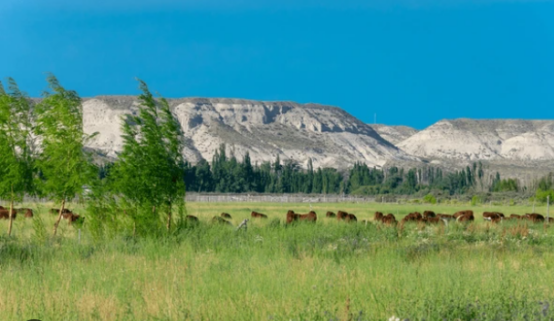
The Chubut grasslands are located in northern Patagonia and are the border of the South American grasslands. One end of the grasslands extends to the eastern foothills of the Andes Mountains, and the other end gradually extends to the Atlantic Ocean.
It is not as gentle and fertile as the Pampas, but drier and colder, with sparse grass, hard ground, and stones exposed in the wind, like old memories being turned up.
You won’t easily encounter forests or lakes here, and there aren’t many animals either. There are only a few gray vultures cruising at very high altitudes, as if silently assessing the weight of time.
Here, it’s a pared-down Earth,
its colors compressed into gray, yellow, and earthy green; the only sounds, aside from the wind, are silence.
The grass here doesn’t grow, it persists
The grass on the Chubut grassland is not “lush”, it is more like the stitches of time: sewing the path of the wind step by step.
Lichens, shrubs, and small grasses…are not tall, yet they possess a tenacious presence that keeps their figures low. They seem like forgotten residents, clinging to their lives without arguing or protesting.
The grasslands here never reach a dazzling green stage; they are always dull. They grow not for beauty but for immortality.
The wind blows all day long, and they just sit there, tilting, swaying, and then returning to their original position.
This is not fragility, this is trained softness.
The Welsh village slowly fades away in the grassland
In the 19th century, a group of Welsh people crossed the ocean and arrived in this almost uninhabited grassland. They built villages in Chubut, dug canals, planted wheat, and recreated their hometown in the dry grassland.
Their descendants still exist today, but many of their houses have been swallowed by the wind into the horizon. What they left behind are strangely spelled place names, teahouses, and brick-red churches.
The Welsh language still lingers on the village walls, peeling like stickers. You can even hear the language they exchange with the wind: a kind of loneliness of a stranger, a tolerance for the landscape.
The grassland does not remember the names of those who came, but only remembers that they once worked with their heads down.
The grassland economy on the backs of sheep is now only left with footprints
Once upon a time, Argentina was the “meat bank of the world,” and the Chubut grasslands were part of its sheep industry.
Millions of Merino sheep grazed here, producing wool that was then sheared and shipped to Europe. There were more sheep than people, and more footprints than trees.
But today, the glory of the wool economy has vanished with the wind. Many pastures are abandoned, sheep pens are crumbling, and barbed wire makes a hollow sound in the wind.
Only the weeds on the ground are still growing, finding a space for survival among the once bustling footprints.
On the grassland, the wind is the last narrator
There are no tall buildings, no shelter, and no noise – this makes the Chubut grassland the exclusive theater of the wind.
The wind here is not the background, but the content. You can hear it dragging time back and forth on the surface of the earth, and you can also feel it telling you stories that have never been told.
It is not a gentle wind, but the kind of wind that writes on your face. In front of it, human words seem too short, too quick, and too impatient.
And the grassland chose to listen.
In the sound of the wind, people finally learned to slow down.
Travelers often say that there is “nothing to see” in the Chubut grasslands.
But what they missed was something that takes time to see clearly:
a world where slowness is the core grammar.
A place where you can stop and listen to whether your heartbeat is still regular.
The Chubut Grassland teaches you not the fullness of vision but the scarcity of existence. It uses the fewest objects to form a minimalist earth stage, and then lets the wind perform a solo show.
When you leave here, you may not take away any scenery, but you will remember a rhythm: the rhythm of the wind, the rhythm of silence, and the rhythm that plants refuse to give up.