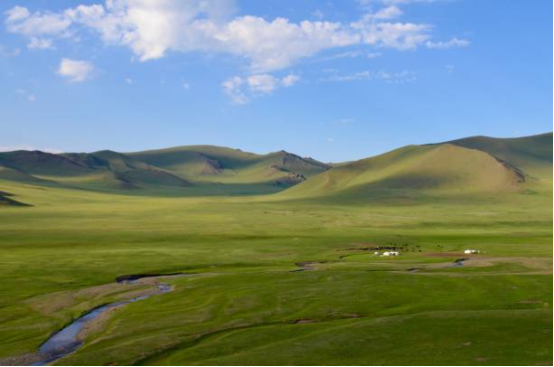
The wind is the oldest resident of this grassland.
It does not live in any yurt, nor does it accept any tribute. Where does it come from? Perhaps it comes from a lost vowel, starting from the valley in southern Siberia, gently brushing the back of the reindeer’s ears, and then entering this vast Mongolian Plateau with great fanfare.
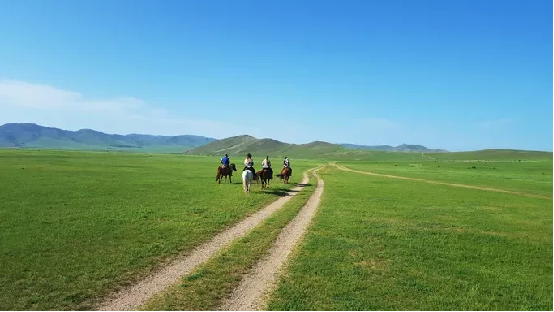
This is one of the highest temperate grasslands on Earth. It belongs not to the trees, nor to the river, but to the wind and the riders. The silhouettes of those riders on saddles always have an almost ancient simplicity, as if time has turned a corner at their shoulder blades and returned to the thirteenth century.
They did not sign a contract with the grassland, but relied on each other tacitly
The grass on the Mongolian Plateau is not gentle. It is short and thick, like a soldier accustomed to the discipline of wind and sand; and its roots are hidden deep, deeper than you can imagine, just like the most silent nomadic old man on the grassland. He doesn’t speak, but his horse’s hooves know the direction, and his eagle knows when to fold his wings.
If you pass by this area at dusk, you will see a few flocks of sheep moving slowly, their silhouettes stretched out, all the way to the low hills in the distance. There are no pastoral songs, no lights of cars guiding the way, only something that cannot be described as loneliness or faith – hanging in the air, like the tail of the wind.
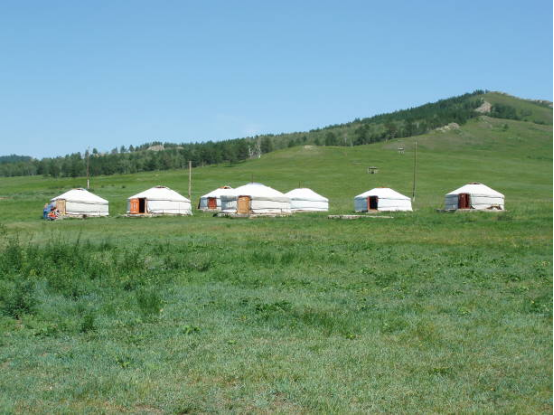
Yurt: A universe moving with the wind
They never build their houses completely. Their roofs are round because the wind has no boundaries. The yurt is like a miniature version of the grassland universe, with wooden beams converging towards the center, just like all the dreams on the grassland, which will eventually return to the order of the round sky and square earth.
The brazier burned in the center of the yurt, and goat milk tea was constantly refilled. There was no loud talk of politics, no overly described idealism, only the sound of boiling water on the edge of the pot and the nasal voice of the children. The real vastness is never the area, but the fact that life can unfold slowly and unhurriedly.
A civilization named after the wind
If you want to understand the Mongolian Plateau, you must first learn to listen to the wind. It is not a background sound, but the main narrator. The sound of horse hooves is just a period, the real subject, the kind of existence that you have to squint your eyes to see clearly.
The annual Nadam Festival is the most solemn response of this grassland to time. Wrestling, archery, horse racing – not competition, but more like a silent dialogue with ancestors. They say with their bodies: We are still here. The wind understands and will turn back to blow gently across your forehead. At that moment, you know that the grassland has forgiven you.
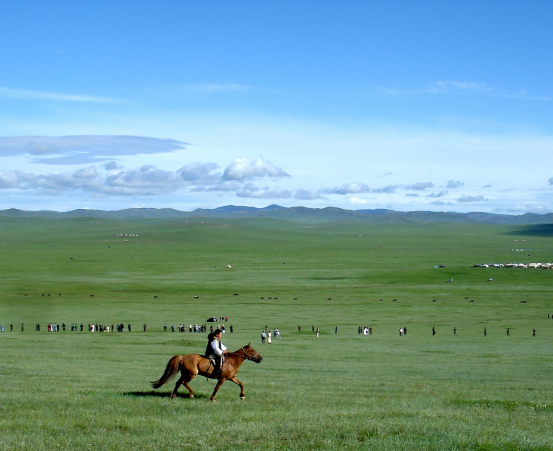
The distance between you and the grassland is only a dream of riding a horse
The Mongolian Plateau is not a geographical type, it is more like an attitude. It allows you to come with questions, but also allows you to say nothing, just ride a horse and disappear in the wind.
The grassland does not force you to understand it, but only hopes that you can feel it quietly. Even if it is only once, it is enough.