Educational notice: This site provides independent educational information only. Content about disasters, safety, health, survival, weapons, ecology, or environmental risk is not professional, medical, legal, engineering, emergency-response, or safety advice. Consult qualified professionals and official local authorities before making decisions.
In the heart of the United States and Canada, the endless Great Plains seem to be always overlooked. But this seemingly “empty” land has witnessed the galloping of tens of millions of bison, the rise of agricultural empires, and energy windmills standing in rows on the horizon. It is like a silent epic, slowly but never stopping, telling the entanglement and dance between man and nature.
1. Bison territory
Before the 19th century, the Great Plains of North America was not the “world’s granary”, but the territory of bison. At that time, there were about 30 million bison migrating on this land, and the sound of their hooves shook the earth, as if it was the beating heart of the grassland. Short grass and mixed grasses drifted in the wind, and prairie dogs, black-footed ferrets, wild horses, wolves, and flocks of migratory birds together formed a nearly complete grassland ecological puzzle.
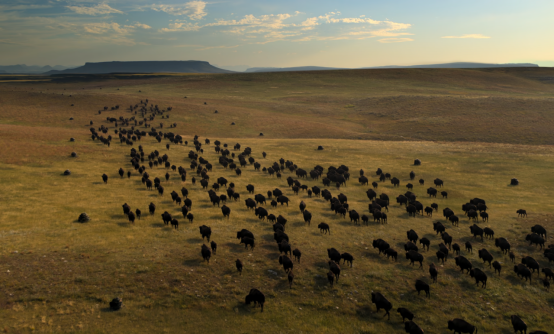
The indigenous tribes, such as the Sioux and Cheyenne, relied on bison for more than just “food”. Bison were their clothing, tools, beliefs, and living totems. In that era, there was no master-servant distinction between man and nature, but rather a symbiotic understanding, a mutual fulfillment that was deeply rooted in their bones and blood.
Until the gunfire of European colonists broke this balance. Large-scale slaughter pushed the bison to the brink of extinction in a few decades – in 1890, there were less than a thousand bison left in North America. This was not only an ecological disaster, but also crushed the foundation of indigenous culture. Without the bison, the soul of the tribe seemed to have lost its home.
2. From wasteland to granary
After the bison left the Great Plains, another group of “conquerors” arrived – farmers, ranchers, pioneers, who brought plows, seeds, railroad tracks and dreams.
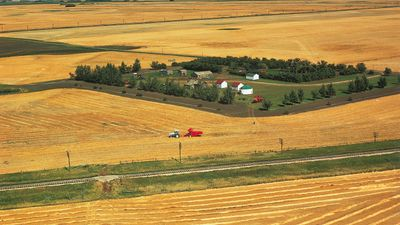
(1) The Golden Age of Agriculture and the Dust Bowl
The northern Great Plains have an amazing black soil layer that is so fertile that it seems to be made for farming. Kansas, Nebraska, South Dakota… one state after another gradually turned into a sea of wheat fields, corn fields and soybeans. Mechanized agriculture swept across the grasslands, and it became the “bread basket of the world”.
However, there are hidden dangers behind the gold. In the 1930s, the “black storm” came. Overcultivation caused the soil to lose its structure. When the wind blew, the entire continent seemed to collapse. In those years, people almost forgot what color the sky was. Millions of acres of land became barren, and farmers fled with their families. It was also from then on that the term “soil protection” began to appear frequently in policy reports. People realized that the earth is not a machine with unlimited supply.
(2) Pastures and beef cattle
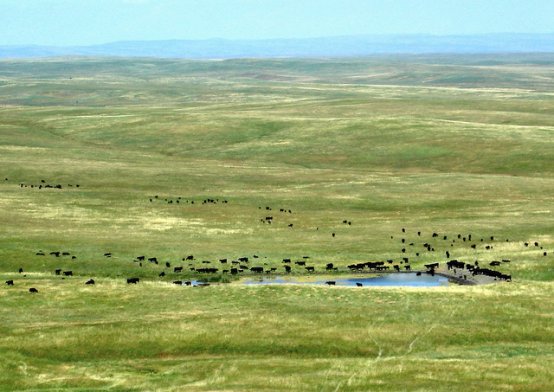
Although bison no longer dominate the grasslands, their shadows still lurk in modern animal husbandry. Texas, Oklahoma and other places are gradually becoming the heartland of beef power. Today’s pasture management is no longer based on grazing by feel, but on algorithms, rotational grazing systems, and native grass restoration to maintain grassland health. In a sense, this is a “scientific succession” to the ecological role of bison.
3. Symbiotic Consciousness
If the Great Plains was an object to be “conquered” in the past, it is now more and more like an old friend in the process of reconciliation – having experienced tearing and destruction, it is slowly recovering the rhythm of life.
(1) Return of the Buffalo
Today, there are about 500,000 bison scattered across reservations and Native lands. The Rose Sioux Reservation in South Dakota is an iconic example of a renaissance that is not only restoring bison populations, but also reconstructing an ecological worldview – bison are guardians of the land and carriers of culture.
(2) Agricultural regeneration
More and more farms are beginning to introduce traditional practices of indigenous peoples, such as periodic burning of grasslands, planting cover crops, and restoring wetlands. These “old methods” have been given a new name: “regenerative agriculture.” In fact, it is not new, but humans are finally willing to let go of their obsession with “control” and relearn how to “coexist.”
Remarkably, Native Americans now manage more than 9 million acres of land, which has become a safe haven for endangered species and bison and is part of a cultural consciousness—a slow-moving experiment in ecological restoration.
(3)Energy: Wind power
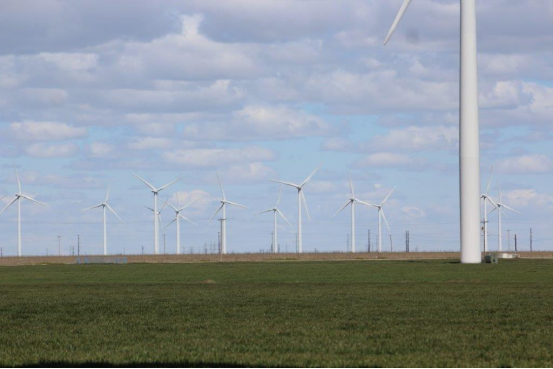
Standing on the Great Plains today, looking across wheat fields, grasslands and pastures, you can often see wind turbines standing in rows. They are no longer just a symbol of industry, but more of a metaphor for hope. In the wave of energy transformation, the Great Plains has become a major center for wind power generation and has found a new path to coexist harmoniously with nature.
4. A place where many parties meet
Today’s grassland is not just a grassland for one person, it is the intersection of interests of multiple parties – herders, governments, scientists, indigenous peoples, environmental protection organizations… all have left their marks on this land.
The World Wildlife Fund launched the Sustainable Pasture Initiative in 2011, trying to make ecological protection and economic interests no longer conflicting. The Central Grasslands Roadmap is an ecological blueprint spanning the United States, Canada, and Mexico, with the goal of weaving a complete grassland protection network across national borders.
Thanks to these efforts, the more than 23 million acres of public grasslands that have not been destroyed have also preserved the habitats of typical species such as sage grouse and Smith’s pipit, while continuing to provide grazing resources for ranches. This coexistence of public and private, modern and traditional, economic and ecological has become possible here.
Epilogue: How should we talk to the grassland?
The story of the Great Plains is not just about bison or agriculture. It raises a big question: How do we get along with nature? Do we become exhausted through taking, or do we find renewal through cooperation?
Protecting the grassland does not mean returning to a “perfect past”, but leaving room for choice for the future. Where the wind blows and the grass is low, the tacit understanding between man and nature is quietly being rebuilt. Perhaps this is the most moving chapter.